IP Innovative Publication Pvt. Ltd.
IP Innovative Publication Pvt. Ltd.
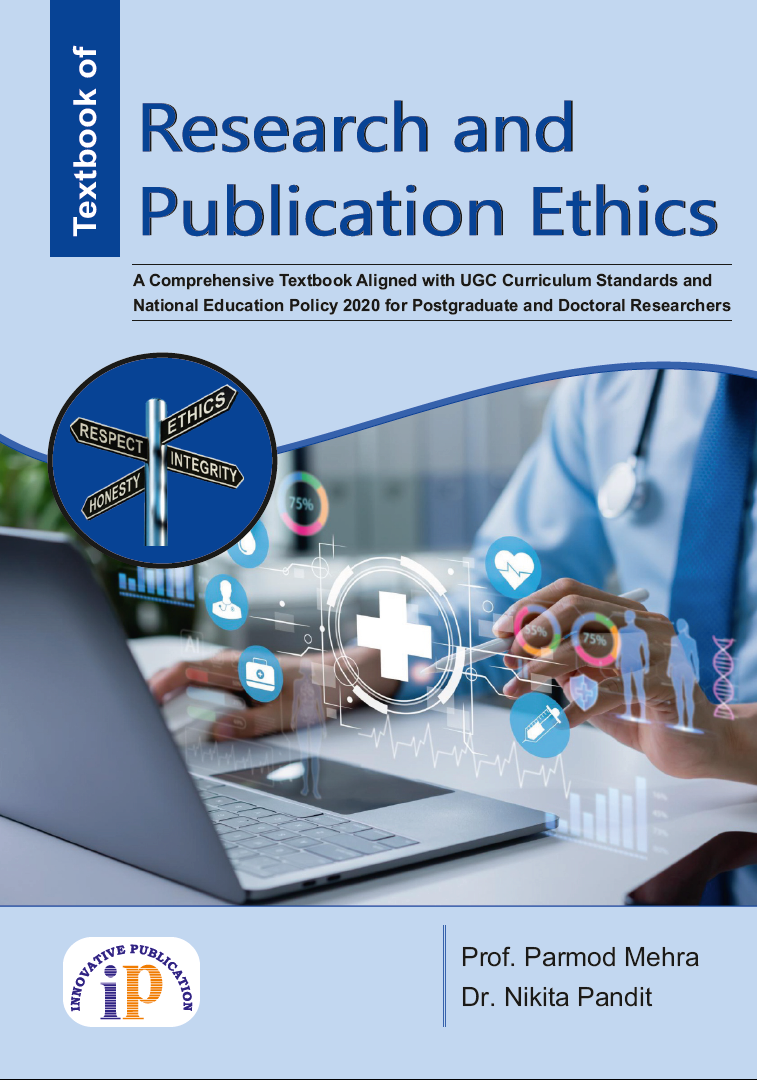
The authors of "Textbook of Research and Publication Ethics" are Prof. Parmod Mehra, Dr. Nikita Pandit.
If you want to download the PDF of Textbook of Research and Publication Ethics, it is not allowed. However, you can immediately access the book by purchasing the ePub with a % discount.
If you want to download a Free PDF of Textbook of Research and Publication Ethics, it is not allowed. However, you can immediately access the book by purchasing the ePub with a % discount.
The question that prompted this book is deceptively simple: what must a researcher know to conduct their work honestly, responsibly, and with due regard for the people, communities, and knowledge systems their research engages?
The answer, as the seventeen chapters of this book demonstrate, is neither simple nor static. Research ethics is not a fixed body of rules to be memorized and applied. It is a dynamic field of inquiry — shaped by the evolution of research practice, the development of new technologies, the shifting demands of the regulatory landscape, and the ongoing efforts of researchers, institutions, and communities to understand what responsible research requires in contexts that could not have been anticipated when the foundational frameworks were developed.
This book has been written for postgraduate and doctoral researchers in Indian universities, and for the supervisors, institutional administrators, ethics committee members, and research integrity officers who support them. It takes Indian regulatory frameworks seriously — the ICMR National Ethical Guidelines, the UGC Regulations, the CDSCO New Drugs and Clinical Trials Rules, the Digital Personal Data Protection Act, the Biological Diversity Act, the Patents Act — not as background context but as central analytical material. At the same time, it situates Indian frameworks within the global research ethics landscape, identifying where India has achieved meaningful alignment with international standards and where significant governance gaps remain.
The book is organized into 9 Parts covering seventeen Chapters. Parts I and II establish the conceptual and methodological foundations of research ethics. Parts III through VI address the principal domains of research conduct: participant protection, publication integrity, plagiarism and AI, and data management. Parts VII and VIII examine collaborative research ethics, legal and institutional governance, and the emerging challenges of digital and platform-based research. Part IX looks to the future: global harmonization, ethics education and institutional capacity building, and the emerging challenges from artificial intelligence, open science, and knowledge sovereignty that will define the ethics agenda for the coming decade.
Each chapter follows a consistent structure designed to support active learning: a Chapter Overview and Learning Objectives; Conceptual Foundations; numbered Units covering the chapter’s substantive content; Comparative Analysis tables placing Indian frameworks in global context; Case Studies drawn from documented research ethics situations in Indian and international settings; Identification of Gaps in current governance; Emerging Issues and Future Directions; a Chapter Summary; Keywords; and three tiers of Review Questions progressing from short-answer recall to analytical argument to case-based application. Suggested Readings at the close of each chapter direct readers to primary regulatory documents, international guidelines, foundational texts, and open-access resources.
Research ethics is ultimately about trust: the trust of participants who consent to be involved in research, the trust of the public who fund it, and the trust of the scholarly community who rely on published findings to build knowledge. Maintaining that trust requires more than individual commitment to honest practice; it requires institutional infrastructure, governance frameworks, and education systems that make ethical research the default, not the exception. This book is a contribution to building that infrastructure, one reader at a time.
Prof. (Dr.) Parmod Kumar Mehra is a Professor of English at Indira Gandhi National Open University, New Delhi. He is a noted scholar of Australian Studies and a recipient of the Australia India Council Fellowship. His academic interests include Research Methodology, World Literatures, Literary Theory, Criticism. He is also engaged in Translation Studies and interdisciplinary research. He has authored eight books on research methodology, literature, criticism, and translation.
He has organized several national and international seminars to promote academic dialogue. He has represented India in multiple countries, advocating peace, equality, and global citizenship. He serves as the Vice President of the Comparative Literature Association of India and has been honored as Ambassador for Peace by the Universal Peace Federation.
Dr. Nikita Pandit is an accomplished research leader, entrepreneur, and research ethics expert with over 24 years of experience in academia. She is the Founder and Director of IP Innovative Publications Pvt Ltd, established in 2014 to empower scholars and promote high-quality, ethical research.
As Director Academics at the Integrated Institute of Medical & Health Sciences Dr. Nikita is recognized for her impactful research, prolific publications, and ability to communicate complex ideas to diverse audiences as a speaker and mentor. Her expertise spans academic research, public engagement, and event management. She has contributed extensively to scholarly literature, addressing critical societal issues through ethical, evidence-based research.
She has organized several national and international seminars to promote ethics in research and publication. Her ultimate goal is to leave a lasting impact on the academic and research community by nurturing a culture of innovation, ethical practice, and lifelong learning.
At IP Innovative Publication, we also offer a collection of insightful and thought-provoking books covering a wide range of subjects. Our books are authored by experts and researchers in their respective fields, providing valuable knowledge and perspectives to readers.
2025 © All rights reserved by 🔗 IP Innovative Publication Pvt. Ltd.