IP Innovative Publication Pvt. Ltd.
IP Innovative Publication Pvt. Ltd.
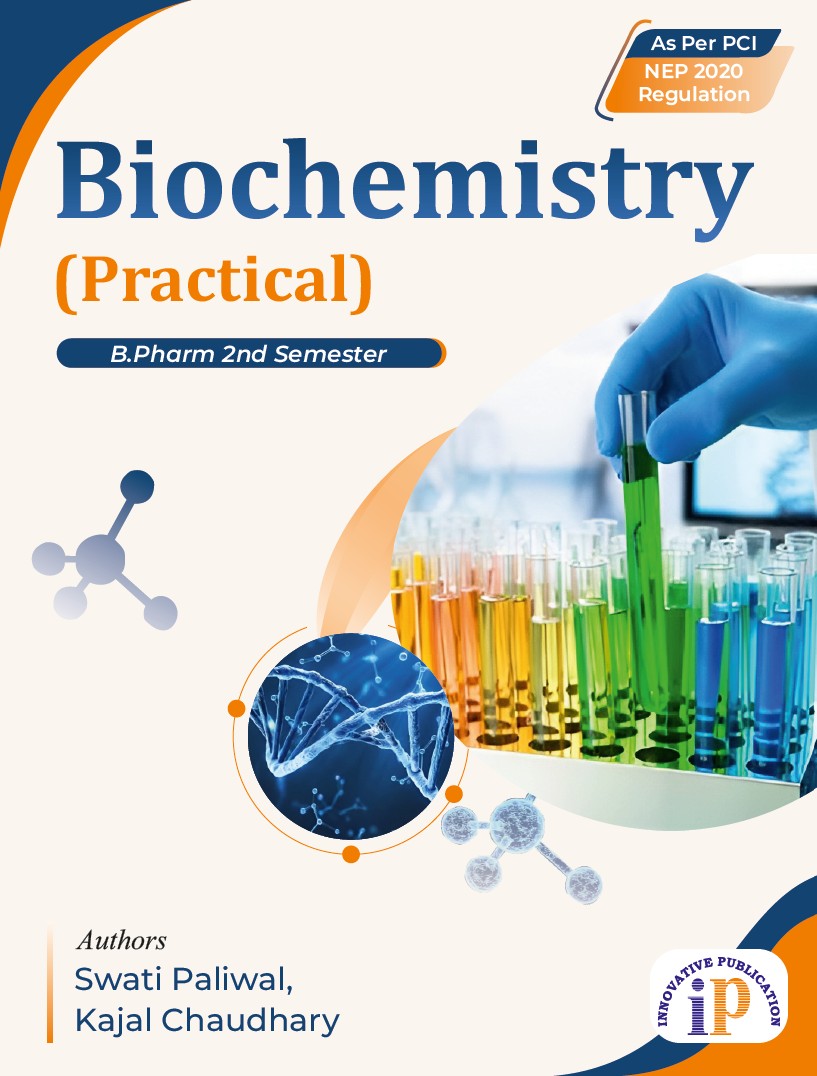
The authors of "Biochemistry (Practical) B.Pharm 2nd Semester As Per PCI NEP 2020 Regulation" are Swati Paliwal, Kajal Chaudhary.
If you want to download the PDF of Biochemistry (Practical) B.Pharm 2nd Semester As Per PCI NEP 2020 Regulation, it is not allowed. However, you can immediately access the book by purchasing the ePub with a % discount.
If you want to download a Free PDF of Biochemistry (Practical) B.Pharm 2nd Semester As Per PCI NEP 2020 Regulation, it is not allowed. However, you can immediately access the book by purchasing the ePub with a % discount.
Biochemistry is an essential subject in pharmaceutical education that provides a scientific understanding of the chemical processes occurring within living organisms. It deals with the structure, properties, functions, and metabolism of biomolecules such as carbohydrates, proteins, lipids, and amino acids, along with the biochemical reactions that support normal physiological functions. A knowledge of biochemistry helps pharmacy students understand the biochemical basis of health and disease and establishes a foundation for studying advanced subjects such as human physiology, pharmacology, clinical biochemistry, and pharmaceutical sciences.
This Biochemistry Practical Book has been specifically prepared for B.Pharm Second Semester students to support their practical learning and help them develop the knowledge and laboratory skills required for the systematic study of biochemical substances and reactions. The manual aims to bridge the gap between theoretical concepts and their practical applications by providing a structured approach to laboratory experiments. It is designed to assist students in understanding experimental principles, following appropriate procedures, observing reactions, recording results, and drawing scientifically appropriate conclusions.
The book covers a wide range of experiments related to the qualitative and quantitative analysis of important biomolecules. The initial experiments focus on the identification of carbohydrates, including glucose, fructose, lactose, maltose, sucrose, and starch, as well as the identification of proteins such as albumin and casein. Quantitative estimation experiments introduce students to the determination of reducing sugars by the DNSA method and proteins by the Biuret method. These practical exercises help students understand the analytical techniques commonly used for the detection and estimation of biochemical constituents.
The manual also includes experiments related to the qualitative analysis of abnormal constituents in urine and the estimation of clinically relevant biochemical parameters, including blood creatinine, blood glucose, and serum total cholesterol. These experiments introduce students to the importance of biochemical investigations in understanding physiological conditions and assessing health-related parameters. In addition, the preparation of buffer solutions and measurement of pH provide practical knowledge of acid–base balance and the importance of maintaining suitable pH conditions in biological systems.
Several experiments are devoted to enzyme activity and the factors influencing biochemical reactions. These include the enzymatic hydrolysis of starch, the study of salivary amylase activity, and investigations into the effects of temperature and substrate concentration on enzyme activity. Through these experiments, students can develop an understanding of enzyme function, reaction conditions, and the factors that influence the rate of biochemical processes. The practical study of lipids and amino acids further familiarizes students with the properties and identification of important biological molecules. The separation of amino acids by thin-layer chromatography (TLC) introduces students to a basic separation technique used in biochemical analysis.
Each experiment is intended to guide students through the essential components of practical work, including the aim, principle, requirements, procedure, observations, calculations where applicable, results, and precautions. This organized presentation encourages students to perform experiments systematically, maintain accurate laboratory records, interpret their observations, and develop analytical thinking. Students are encouraged to understand the underlying scientific principles rather than merely memorize experimental procedures.
Laboratory safety is an important component of practical education. Therefore, students should follow the prescribed precautions, handle chemicals and biological samples responsibly, maintain cleanliness, and use laboratory equipment appropriately. Attention to these practices helps promote accuracy, reliability, and responsible laboratory conduct.
This manual is intended to serve as a useful learning resource during regular practical classes, internal assessments, university practical examinations, and viva-voce preparation. It may also help students revise important biochemical concepts and strengthen their confidence in performing laboratory experiments.
Overall, this Biochemistry Practical Book seeks to provide B. Pharm Second Semester students with a strong foundation in biochemical analysis and experimental techniques. By combining theoretical understanding with practical experience, the manual aims to develop essential laboratory competencies and prepare students for further learning in pharmaceutical and biomedical sciences. It is hoped that this book will serve as a valuable academic companion and contribute meaningfully to the students educational and professional development in the field of pharmacy.
Swati Paliwal is a Ph.D. Research Scholar in the Department of Pharmaceutical Chemistry at Delhi Pharmaceutical Sciences and Research University (DPSRU), New Delhi, India. She has three years of teaching experience and one year of experience in Research and Development (R&D), reflecting her commitment to both academic excellence and scientific research.
She has successfully qualified the Graduate Pharmacy Aptitude Test (GPAT), a national-level examination in the field of pharmaceutical sciences. Her academic and research interests focus on Pharmaceutical Chemistry, Medicinal Chemistry, Drug Design and Discovery, and the development of novel therapeutic agents.
Her research work is particularly directed towards the design, synthesis, biological evaluation, and computational investigation of novel nitrogen-containing heterocyclic compounds as potential therapeutic agents. Through her combined experience in teaching and research, she aims to contribute to pharmaceutical education, innovative drug discovery, and the advancement of pharmaceutical sciences.
She is passionate about integrating theoretical knowledge with practical research approaches to support the development of effective and innovative therapeutic strategies.
Kajal Chaudhary is an Assistant Professor at Ram-Eesh Institute of Vocational and Technical Education, Greater Noida, Uttar Pradesh, India and is currently pursuing her Ph.D. in Pharmacy. She has been actively involved in teaching, academic mentoring, research, and institutional activities.
Her primary research interests include novel drug delivery systems, nanotechnology-based drug delivery, lipid-based nanocarriers, herbal drug formulations, pharmaceutical formulation development, and optimization of drug delivery systems. Her doctoral research focuses on the formulation, optimization, and evaluation of herbal-loaded cubosomes for potential applications in arthritis management.
She has published 21 research and review articles in reputed national and international journals and has contributed to 3 books and 7 book chapters, including publications associated with internationally recognized publishers such as Springer, Taylor & Francis, Bentham Science, and Nova Science Publishers. Her research contributions cover emerging areas such as cubosomal drug delivery, phytosomes, microneedle technology, nanomedicine, artificial intelligence and machine learning in pharmacology, herbal therapeutics, and advanced pharmaceutical technologies.
In addition to her research publications, she has authored academic textbooks for Diploma in Pharmacy students and contributed chapters addressing herbal excipients, controlled drug delivery, biocomposite nanomaterials, and the therapeutic applications of natural products. She has actively participated in national and international conferences, scientific seminars, faculty development programmes, workshops, and academic activities, and has presented her research at scientific forums.
Her professional achievements include receiving the Young Researcher Award (2026) and the Best Faculty Award (2026). She has also received recognition for research publications in high-impact-factor journals during 2025 and 2026. Through her contributions to pharmaceutical education and scientific research, she remains committed to promoting interdisciplinary research, encouraging innovation among pharmacy students, and advancing emerging pharmaceutical technologies for improved healthcare outcomes.
At IP Innovative Publication, we also offer a collection of insightful and thought-provoking books covering a wide range of subjects. Our books are authored by experts and researchers in their respective fields, providing valuable knowledge and perspectives to readers.
2025 © All rights reserved by 🔗 IP Innovative Publication Pvt. Ltd.