IP Innovative Publication Pvt. Ltd.
IP Innovative Publication Pvt. Ltd.
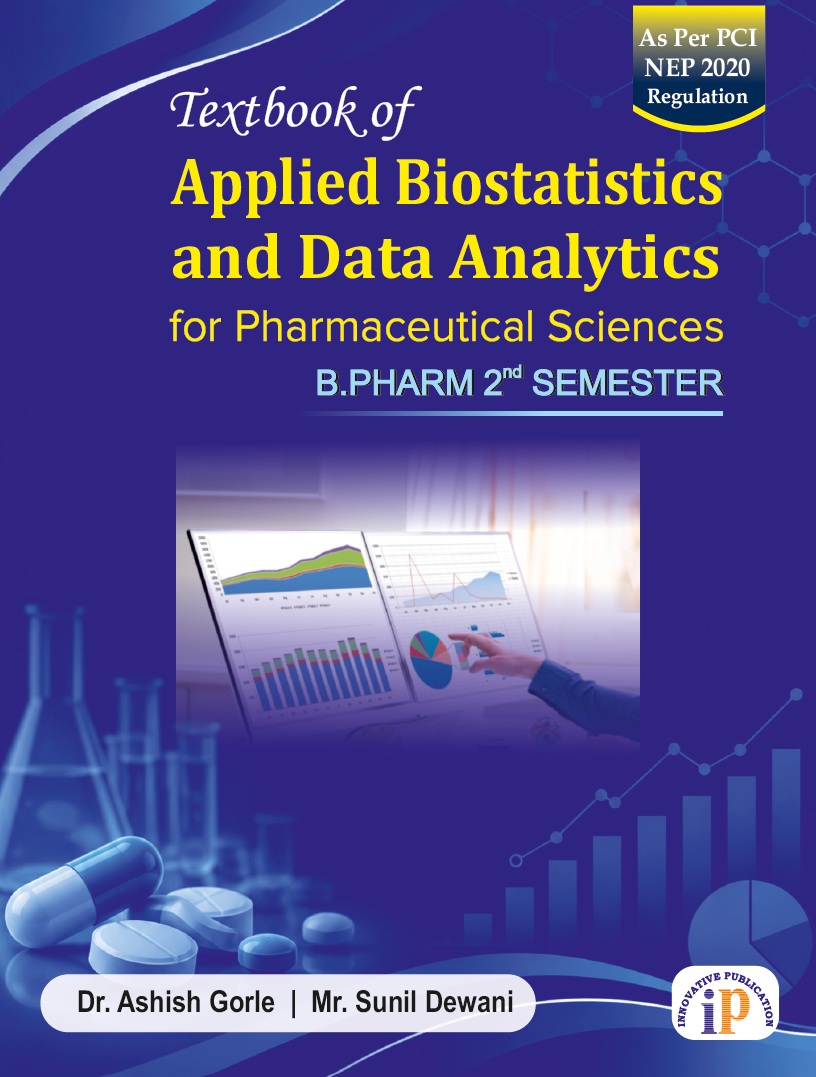
The authors of "Textbook of Applied Biostatistics and Data Analytics for Pharmaceutical Sciences" are Dr. Ashish Gorle, Mr. Sunil Dewani.
If you want to download the PDF of Textbook of Applied Biostatistics and Data Analytics for Pharmaceutical Sciences, it is not allowed. However, you can immediately access the book by purchasing the ePub with a % discount.
If you want to download a Free PDF of Textbook of Applied Biostatistics and Data Analytics for Pharmaceutical Sciences, it is not allowed. However, you can immediately access the book by purchasing the ePub with a % discount.
This book was written for the second-semester Bachelor of Pharmacy student who has not yet been asked to think statistically, and for the teacher who has been asked to make that thinking possible in thirty lecture hours. It follows, unit by unit, the NEP 2020 syllabus for BP201T: Applied Biostatistics and Data Analytics for Pharmaceutical Sciences. The five chapters are the five units of that syllabus. Nothing required has been omitted; a modest amount that the syllabus implies — the log-normal distribution, the odds ratio’s cousins, the anatomy of a statistical report — has been added because a working pharmacist will meet it within a year of graduating.
The pedagogical choices are deliberate. First, every new idea is introduced with a pharmaceutical question, not with a formula. The formula arrives once the question has been felt. Second, description always precedes inference. Students who jump to p-values before they have looked at a histogram become the analysts who later miss the outlier that was driving the “significant” result. Third, Python is not an appendix. From Chapter 1 onward the same libraries the industry uses — NumPy, Pandas, SciPy, Statsmodels, Matplotlib — are shown in short, copyable sessions, with the traps (np.std using n not n−1; Statsmodels OLS fitting no intercept unless told) named as they arise. No prior coding is assumed. Google Colab is sufficient.
Fourth, the book is case-based in spirit throughout and case-based in structure in Chapter 5. Batch PCM-2409, a thirty-tablet paracetamol dataset, is described, correlated, modelled and reported endto- end, so that the student finishes the course having produced one complete, reproducible analysis rather than a pile of disconnected exercises. Fifth, questions are not decorative. Each chapter ends with objective, multiple-choice, short and long questions, and the answers are written as teaching, not as keys. A student who works them has revised the chapter.
How to use the book. Teachers will find that Chapters 1–3 occupy the first half of the semester and Chapters 4–5 the second; Chapter 5’s three case studies make natural practical demonstrations even though BP201T is a theory course. Students should keep a notebook — paper or Colab — and retype every worked example. Statistics that is only read is not yet statistics that can be done. The chapter opener illustrations, the numbered outlines and the abstracts are there to orient; the worked examples and the Python sessions are there to train.
A note on language and honesty. Where the statistical literature is divided (one-sided tests, the word “significant”, the cult of p < 0.05), the book takes a conservative, regulator-facing position and says so. Where a calculation is shown in Python, the same calculation is shown by hand at least once, so that the computer never becomes a black box. Where a result is uncertain, the text refuses to tidy it.
This first edition may have faults. Notifications of errors, and of pharmaceutical examples that would teach better than the ones used here, will be gratefully received. The book exists to serve the B. Pharm. classroom; the classroom should talk back.
Dr. Ashish Gorle, currently serving as Dean (Academics); Professor and Head of the Department of Pharmaceutics at R. C. Patel Institute of Pharmaceutical Education and Research, Shirpur, Maharashtra. He has over 22 years of experience in teaching and research at the same institute. He has been consecutively nominated for the second term as a Board of Studies (BoS) member in Pharmaceutics at Kavayitri Bahinabai Chaudhari North Maharashtra University (KBCNMU), Jalgaon, Maharashtra.
Dr. Gorle obtained his Bachelor's degree in Pharmacy from Amravati University, Amravati, in 2002, followed by a Master's degree in Pharmacy from KLE Society's College of Pharmacy, Belgaum, under Rajiv Gandhi University of Health Sciences (RGUHS), Bengaluru, Karnataka, in 2004. He earned his Ph.D. in Pharmacy from North Maharashtra University, Jalgaon, in 2011.
Dr. Gorle has guided more than 80 M.Pharm students and is currently supervising five Ph.D. scholars, three of whom have successfully been awarded their doctoral degrees under his guidance. His research contributions include 65 national and international research publications, three patents, and one international book chapter. He has also completed two major and minor research projects funded by the University Grants Commission (UGC), New Delhi, and is currently working on a research project funded by KBCNMU, Jalgaon.
In recognition of his research contributions, Dr. Gorle has received the Best Research Award from Kavayitri Bahinabai Chaudhari North Maharashtra University, Jalgaon. His research interests primarily focus on pharmaceutics and novel drug delivery systems, with an emphasis on pharmaceutical formulation development, evaluation, and advancement of drug delivery technologies.
Mr. Sunil Dewani, working as Asst. Prof., Department of Pharmaceutics, Institute of Pharmaceutical Education and Research, Borgaon (Meghe), Wardha, completed his B. Pharm. and M. Pharm. from the parent Institute in 2000 and 2003 respectively, and currently pursuing Ph. D. from Sant Gadge Baba Amravati University, Amravati . He has 22 years of teaching and research experience. He has 27 National and international publications in the journals of high repute. He has guided more than 55 students at post graduate level. He is actively involved in various research areas including – novel formulation technology, 3D printing, nanotechnology, microneedle engineering, Python programming, artificial intelligence, artificial neural network, fuzzy logics and genetic algorithms. He also was involved in the core team of the institute that assisted the institute bagging Grade A+ by NAAC peer team. He is also actively involved at various academic levels in Rashtrasant Tukodoji Maharaj Nagpur University, Nagpur. Today he is going to present his talk on the topic “Harnessing the power of artificial intelligence in shaping pharmaceutical education and research”.
At IP Innovative Publication, we also offer a collection of insightful and thought-provoking books covering a wide range of subjects. Our books are authored by experts and researchers in their respective fields, providing valuable knowledge and perspectives to readers.
2025 © All rights reserved by 🔗 IP Innovative Publication Pvt. Ltd.