IP Innovative Publication Pvt. Ltd.
IP Innovative Publication Pvt. Ltd.
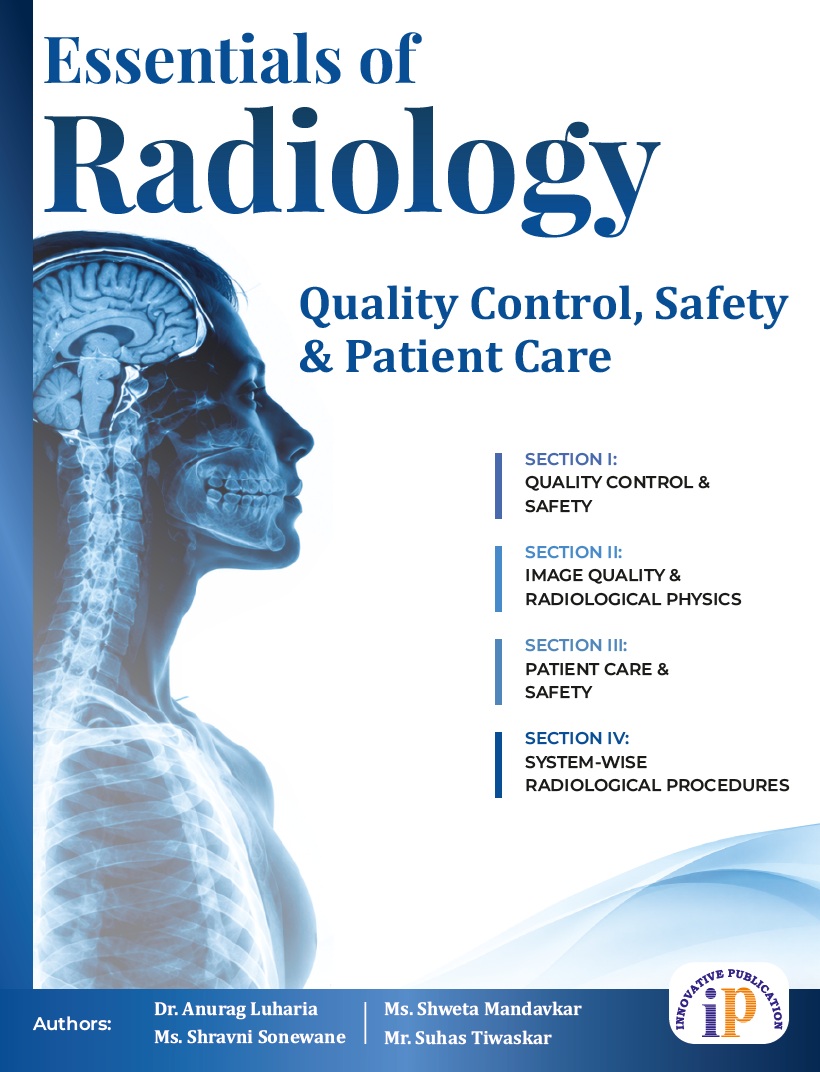
The authors of "Essentials of Radiology: Quality Control, Safety & Patient Care" are Dr. Anurag Luharia, Ms. Shweta Mandavkar, Ms. Shravni Sonewane, Mr. Suhas Tiwaskar.
If you want to download the PDF of Essentials of Radiology: Quality Control, Safety & Patient Care, it is not allowed. However, you can immediately access the book by purchasing the ePub with a % discount.
If you want to download a Free PDF of Essentials of Radiology: Quality Control, Safety & Patient Care, it is not allowed. However, you can immediately access the book by purchasing the ePub with a % discount.
Modern diagnostic radiology stands at the vital crossroads of physical science, advanced computational engineering, and clinical medicine. From the earliest discoveries of X-radiation to today's multidetector computed tomography (MDCT), high-field magnetic resonance imaging (MRI), and artificial intelligence-driven reconstruction, our capacity to peer non-invasively into human anatomy and physiology has expanded exponentially. Yet, with this unprecedented technological capability comes an enduring professional responsibility: every diagnostic image must be clinically justified, technically optimized, and acquired with unyielding regard for patient safety and ethical practice.
Essentials of Radiology: Quality Control, Safety & Patient Care was conceived to bridge the gap between abstract radiological physics and day-to-day clinical execution. Image acquisition is never merely mechanical; it is a mathematically driven, ethically grounded discipline where microscopic technical errors–such as focal spot blooming, generator ripple, or uncorrected geometric magnification–can directly impair diagnostic accuracy, trigger avoidable repeat exposures, and compromise patient outcomes. This textbook provides a comprehensive, systematic framework designed to guide students, radiographers, radiology residents, and medical physicists toward clinical and technical excellence.
The curriculum is structured into four cohesive sections:
1. Section I: Quality Control & Safety establishes the theoretical and applied mechanics of institutional quality control (QC) and quality assurance (QA) programs. It details baseline calibration standards, empirical testing with phantoms and dosimeters, display and hardcopy quality verification, and compliance with international regulatory bodies, all rooted in the fundamental philosophy of ALARA (As Low as Reasonably Achievable).
2. Section II: Image Quality & Radiological Physics examines the core physical parameters of image formation–contrast, spatial resolution, modulation transfer function (MTF), and quantum noise. It thoroughly analyzes the root causes of image degradation, from Compton scattering and focal spot penumbra to anode target aging, and presents concrete corrective measures, including anti-scatter grid physics, beam geometry, high-frequency generator technology, and automatic exposure control (AEC).
3. Section III: Patient Care & Safety transitions from equipment mechanics to the human center of radiological practice. Grounded in core bioethical principles–beneficence, nonmaleficence, autonomy, and justice–this section addresses holistic patient preparation, contrast media pharmacology and risk stratification, emergency management algorithms for adverse reactions, radiation biology (deterministic versus stochastic injury), four-zone MRI safety protocols, infection control, and the integration of artificial intelligence for dose optimization and smart triage workflows.
4. Section IV: System-Wise Radiological Procedures delivers an in-depth, organ-specific exploration of diagnostic imaging. Spanning the central nervous system, respiratory system, cardiovascular hemodynamics, uroradiology, gastrointestinal tract, hepatobiliary system, musculoskeletal system, and reproductive health, each chapter pairs pathophysiological rationale with optimal imaging technique, positioning considerations, and modality selection.
This book is intended to serve as a reliable textbook for undergraduate and postgraduate students in medical imaging technology and radiodiagnosis, as well as a dependable desk reference for practicing technologists, radiologist and clinical medical physicists. It is my sincere hope that this work fosters a deeper appreciation for the physics beneath the beam and instills a steadfast commitment to patient-centric safety across every imaging suite.
Dr. Anurag A. Luharia is presently serving as the Head & Consultant Dept. of Radiological Physics & Radiological safety at Datta Meghe Institute of Higher Education and Research, Sawangi (Meghe), Wardha also he is a Subject Matter Expert for the Adani Healthcare. He has PhD in Radiophysics and persuing his second PhD in Health Professions Education. He has fellowship in Bioethics. He has more than 100 scientific publications in various indices. He has written 25 books and 50 chapters so far, he has more than 20 years of clinical experience. He has commissioned and established various medical diagnostic, therapeutic Radiation facilities.
Ms. Shweta A. Mandavakar is currently serving as a Head of Department at Ramkrishna Paramedical Allied and Healthcare Sciences, Peace Research and Development Foundation. She has academic experience in teaching, curriculum development, and academic coordination in the field of Allied Health Sciences. She has published two research papers and actively contributes to academic and research initiatives. Her core competencies include curriculum planning, lesson plan development, preparation of teaching-learning materials, assessment design, student mentoring, academic documentation, and coordination of educational activities. She is passionate about advancing healthcare education, promoting evidence-based teaching practices, and contributing to research and academic excellence in Allied Health Sciences
Ms. Shrawani Sonewane is currently serving as an Assistant Professor at the Parul Institute of Allied and Healthcare Sciences, Parul University. She has 1.5 years of academic experience in teaching, curriculum development, and academic coordination in the field of Allied Health Sciences. She has published two research papers and actively contributes to academic and research activities. She has served as a core member of the NCAHP inspection committee-related activities at the institute, contributing to the preparation and coordination of institutional documentation and academic requirements for regulatory inspection and government approval. Her academic competencies include curriculum planning, lesson plan development, preparation of teaching and learning materials, assessment design, student mentoring, academic documentation, and coordination of educational activities. She is interested in advancing healthcare education, promoting evidence-based teaching practices, and contributing to research and academic excellence in Allied Health Sciences.
Mr. Suhas Tivaskar is academician and presently serving as an Assistant Professor and Head in the Department of Medical Radiology and Imaging Technology, School of Allied Health Sciences, Adani Institute of Higher Education and Research (Deemed to be University). He is currently pursuing his Ph.D. in Medical Radiology and Imaging Technology. His academic and research interests focus on medical imaging, radiological sciences, computed tomography (CT), radiation dose optimization, and advancements in diagnostic imaging technologies. He has published 30+ scientific publications indexed in Scopus, contributing to the advancement of research in radiological and imaging sciences. He has also authored 3 books and contributed to 25+ book chapters in various radiological specialties. Through his academic, research, and scholarly contributions, he is committed to promoting evidence-based imaging practices, advancing medical radiology education, and fostering innovation in diagnostic imaging.
At IP Innovative Publication, we also offer a collection of insightful and thought-provoking books covering a wide range of subjects. Our books are authored by experts and researchers in their respective fields, providing valuable knowledge and perspectives to readers.
2025 © All rights reserved by 🔗 IP Innovative Publication Pvt. Ltd.